Why California's Aging Population Is Reshaping Long-Term Care

About This Article
California faces a major demographic shift as an aging population drives up long-term care costs, dementia rates and pressure on family caregivers. While the state's Master Plan for Aging aims to address these challenges, many families remain financially unprepared for the high cost of extended care.

James Kelly
LTC News staff writer specializing in long-term care and aging.
Table of Contents
- California's Master Plan for Aging Recognizes a Growing Challenge
- California's Aging Population Reflects a National Transformation
- Why California May Be a Preview of America's Aging Future
- Extended Care Costs Continue to Rise Across California
- Caregiver Workforce Shortage Is Adding Pressure
- Family Caregivers Are Carrying Much of the Burden
- Long-Term Care Insurance Has Paid Nearly $18 Billion to Californians
- Why Many Californians Still Wait Too Long to Plan
- Medicare, Medi-Cal and the Long-Term Care Funding Gap
- California Continues to Explore Public Financing Solutions
- Finding Quality Long-Term Care Services in California
- Dementia Care Requires Additional Evaluation
- What Families Should Look For
- Are You Prepared?
Many experts have long viewed California as a place of innovation and opportunity. Today, however, the state is confronting a challenge that will affect nearly every community, regardless of income level or geography: how to care for a rapidly growing population of older adults.
Sarah Steenhausen, Deputy Director of Policy, Research, and Engagement for the California Department of Aging, states that aging extends beyond healthcare. She says aging affects housing, transportation, caregiving, workforce development, and financial security.
Aging touches everything. It's not just health care. It shows up in housing, transportation, social services, affordability, and how those systems connect to meet the person's needs." — Sarah Steenhausen.
It also raises difficult questions about who will provide care, how that care will be paid for, and whether enough services will be available as demand increases.
State leaders have acknowledged these concerns through California's Master Plan for Aging, a comprehensive strategy designed to improve support for older adults, family caregivers, and people living with disabilities. Yet even as policymakers work toward long-term solutions, families across California are already experiencing the realities of aging firsthand.
California's Master Plan for Aging Recognizes a Growing Challenge
California launched its Master Plan for Aging in 2021 to prepare for profound demographic changes that will reshape the state during the coming decades.
The initiative focuses on helping residents age safely in their homes and communities while strengthening support systems for family caregivers and improving access to long-term services and supports. State leaders have emphasized aging in place, housing accessibility, transportation, workforce development, dementia support, and reducing social isolation among older adults.
Governor Gavin Newsom has made aging in place and with dignity a central theme in his policy agenda, emphasizing that “we all have a role to play” in ensuring older Californians can remain in their homes and communities as they age. The governor has said that the state is getting grayer and "we need to be ready for the major population changes headed our way."
We all have a role to play in ensuring that older Californians can age in place and with dignity." — Gov. Gavin Newsom.
The plan reflects a growing recognition that successful aging involves far more than medical care. Housing, mobility, caregiver support, social connections, and access to services all influence whether older adults can remain independent and maintain quality of life.
California's Aging Population Reflects a National Transformation
California's aging challenges are not unique, but the state's size and diversity make it a preview of what much of America will face in the coming decades.
Federal researchers estimate that 56 percent of people turning age 65 today will eventually require long-term services. For families, where extended care costs in California are among the highest in the nation, the financial implications can be especially significant.
California sits at the center of this demographic transformation. The state is home to one of the nation's largest populations of older adults and one of the largest populations of people living with Alzheimer's disease and related dementias. A UCLA Center for Health Policy Research analysis found more than 719,700 Californians are living with Alzheimer's disease, with an estimated 190,300 Los Angeles County residents age 65 and older living with Alzheimer's and other dementias. By 2040, the number of Californians with Alzheimer's and other dementias is expected to increase by 127 percent, according to the same analysis.
Unlike many states where aging is concentrated in rural communities, California's challenges extend across major metropolitan regions, suburban neighborhoods, and agricultural areas. The state's longevity can be viewed as a success story, but longer lives often increase the likelihood of chronic illness, mobility limitations, cognitive decline, and the eventual need for caregiving support.
Across the United States, demand for care services is increasing faster than the available workforce. Home care agencies report persistent staffing shortages. Assisted living communities and nursing facilities continue struggling to recruit and retain caregivers.
Families increasingly find themselves balancing careers, raising children, and caring for aging parents simultaneously. The impact of aging and long-term care falls on families as well. Jenevieve Rodriguez Liu, MPH, is the Community Engagement and Communications Coordinator for the Family Caregiver Alliance. She recalls her personal experience.
My parents cared for their parents while raising me and my brother and working full-time jobs. My dad was a mailman and my mom worked at Safeway, so they always had their hands full. My mom would tell me about holding my grandmother’s hand to take her to a doctor’s appointment, while towing my brother and me along, making sure none of us fell while crossing the street." — Jenevieve Rodriguez Liu.
She has seen in her professional life how caregivers are often missing in the medical equation.
We concentrate on the person who needs care, but we need to remember that when they go home, there’s someone there caring for them 24/7 — and they’re typically forgotten. That’s a big part of what we do at FCA: making sure caregivers know they’re not alone and that there are resources designed specifically for them." — Jenevieve Rodriguez Liu.
California faces additional pressures. Housing costs are among the highest in the nation, making it difficult for care providers to attract and retain workers. Long-term care employers must compete in expensive labor markets where housing affordability often affects recruitment and retention.
According to the Public Policy Institute of California, median hourly wages for home health and personal care aides were just $15.60 in early 2023—a wage that leaves little room to absorb California's housing costs. The same research found that care workers are significantly more likely than other California workers to change employers or leave the workforce entirely within a four-year period, and that projected shortages for the state's direct care workforce range from 600,000 to more than 3 million workers in the years ahead. California's own Master Plan for Aging has acknowledged the scale of the problem, noting that only about 5 percent of health care providers in California have training in geriatrics.
The state's cultural and linguistic diversity creates opportunities and challenges that many other states face on a smaller scale. Care providers increasingly must offer services that respect cultural traditions, dietary preferences, religious practices, and language needs.
For these reasons, California is often viewed as a national testing ground for aging policy. The successes and shortcomings of the state's approach may provide lessons for other states confronting similar demographic realities.

Why California May Be a Preview of America's Aging Future
Many of the issues California faces today are likely to emerge elsewhere in the coming years. The combination of longer life expectancy, rising health care costs, workforce shortages, and increasing rates of dementia is creating pressure on families and public programs nationwide.
California's experience demonstrates how demographic changes affect not only health care systems but also housing, transportation, employment, and economic planning. The state's efforts to prepare for an aging population may ultimately help shape policy discussions across the country as other states confront similar challenges.
Dementia and Cognitive Decline Are Reshaping California's Long-Term Care System
Few aging-related issues will have a greater impact on California families than Alzheimer's disease and related dementias. According to the Alzheimer's Association's 2026 Alzheimer's Disease Facts and Figures report, an estimated 7.4 million Americans age 65 and older are living with Alzheimer's disease in 2026. The organization projects that number will increase to 13.8 million by 2060 if no major medical breakthrough significantly alters the disease's trajectory.
California has one of the nation's largest populations of people living with Alzheimer's disease and other dementias. The growing number of individuals requiring supervision, memory support, and specialized care is creating additional pressure on families, providers, and public programs.
Dementia creates challenges that extend far beyond medical treatment. Family members frequently become caregivers long before a formal diagnosis leads to professional care services.
Adult children often find themselves managing medications, coordinating physician appointments, overseeing finances, and eventually helping arrange in-home care, assisted living, or memory care. For many California families, dementia becomes the event that exposes both the emotional and financial realities of long-term care.
Extended Care Costs Continue to Rise Across California
The cost of extended care services remains one of the biggest concerns facing aging Californians. Data from LTC News, published in the Cost of Long-Term Care Services Calculator, show that California care costs frequently exceed national averages and continue to rise across many regions.
Regional differences can be dramatic. Costs in San Francisco are substantially higher than those in Sacramento, Fresno, or Inland Empire communities. Housing costs, labor expenses and local demand all influence pricing, making it essential for families to evaluate costs based on their specific location rather than statewide averages.
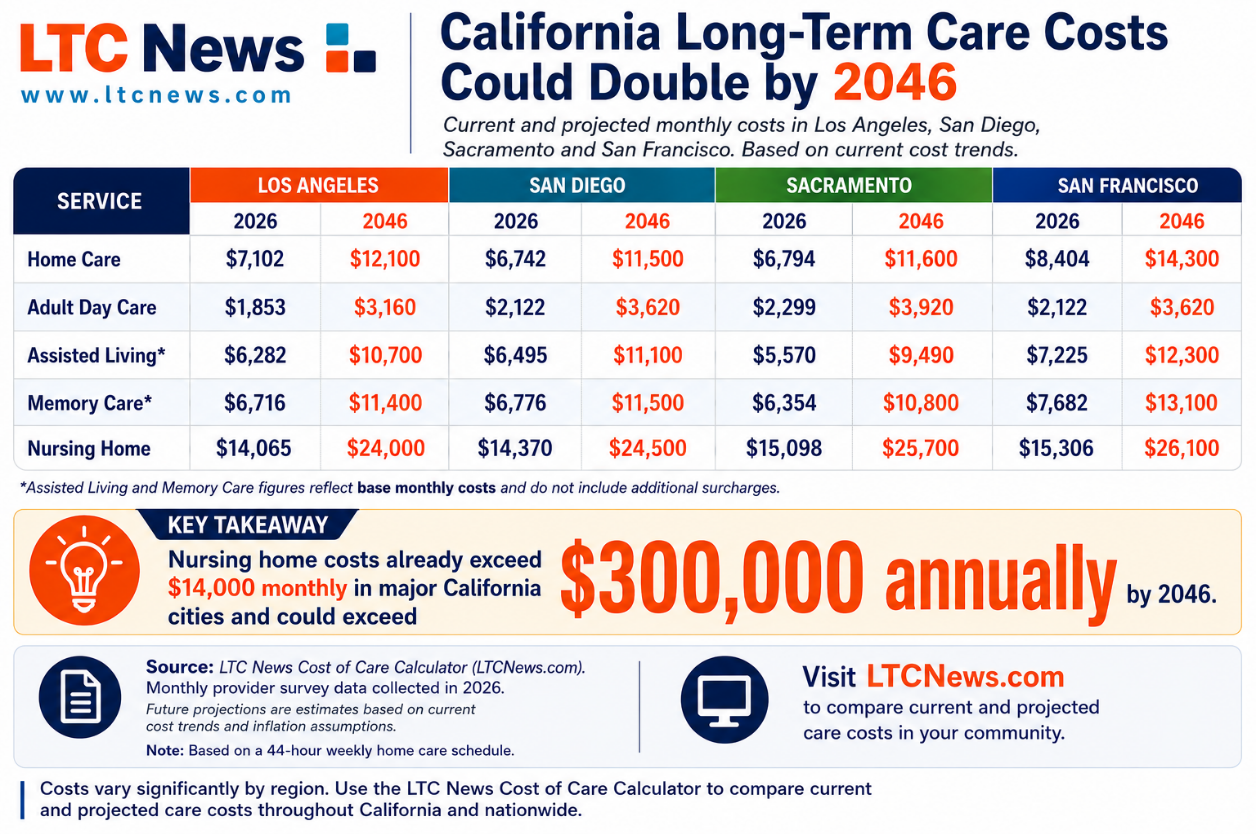
California's long-term care costs vary significantly by region. The LTC News Cost of Care Calculator allows families to compare current and projected costs for home care, assisted living, memory care and nursing home care in communities throughout California and across the nation.
In Los Angeles, home health care now averages more than $7,100 per month, while nursing home care exceeds $14,000 monthly. In San Francisco, home health care averages more than $8,400 per month, and nursing home care exceeds $15,300 per month.
Base assisted living costs range from approximately $5,570 per month in Sacramento (plus surcharges which raise that cost each month) to more than $7,200 per month plus surcharges in San Francisco. Memory care costs are higher still because of the specialized staffing and support required for residents living with cognitive impairment.
Future projections are even more concerning. Based on trends reflected in the LTC News Cost of Care Calculator, nursing home costs in major California markets could exceed $24,000 to $26,000 per month within the next two decades.
These costs illustrate why long-term care has become one of the largest financial risks facing retirees and their families. Even households that have accumulated substantial savings can find those resources depleted by a lengthy care event.
Caregiver Workforce Shortage Is Adding Pressure
California's aging population is growing even as many care providers struggle to recruit and retain workers. Home care agencies, assisted living communities, memory care providers, and nursing facilities throughout the state report workforce challenges.
Competition for workers remains intense, particularly in regions with high housing costs, where caregivers may find it difficult to afford living near the communities they serve. Without enough caregivers, even families with financial resources may struggle to find services when they need them. Workforce shortages can lead to longer wait times for caregivers or facilities, reduced service availability, and increased costs.
The California Master Plan for Aging identifies workforce development as a critical priority. As demand for care continues to rise, addressing caregiver shortages will remain one of California's most important aging-related challenges.
Family Caregivers Are Carrying Much of the Burden
Professional care services are only part of California's long-term care system. Much of the responsibility still falls on family members. Family caregiving often becomes a second full-time job. Adult children may spend years coordinating appointments, managing medications, monitoring finances, and responding to emergencies while balancing careers and raising families of their own.
Spouses, adult children, and relatives frequently provide transportation, meal preparation, medication management, supervision, and assistance with daily activities. Family caregiving often comes with emotional stress, physical exhaustion, and financial sacrifice.
California's Master Plan for Aging recognizes the critical role family caregivers play and seeks to strengthen support systems. Yet many families still struggle to find affordable assistance before caregiver burnout becomes a serious concern.
Long-Term Care Insurance Has Paid Nearly $18 Billion to Californians
One of the most overlooked aspects of California's long-term care system is the role Long-Term Care Insurance already plays in helping families pay for care.
According to the latest state-level data from America's Health Insurance Plans, traditional Long-Term Care Insurance policies paid $1,636,792,480 in benefits to California policyholders during 2024 alone. Historically, traditional Long-Term Care Insurance policies have paid more than $17.79 billion in benefits to Californians since the coverage was first introduced.
Those billions of dollars represent real families who were able to remain at home longer, access assisted living communities, receive memory care services, or obtain nursing home care without immediately exhausting retirement savings.
The $17.79 billion paid to California policyholders demonstrates that long-term care planning is not merely a theoretical exercise. For thousands of families, those benefits have funded years of home care, assisted living, or memory care services that would otherwise have been paid for with retirement savings, investment accounts, or the sale of family assets.
Long-term care planning isn’t theoretical; it’s real protection delivering real care. For thousands of families, those benefits have meant years of home care, assisted living, or memory care that would have otherwise placed a huge burden on family members, drained retirement savings or forced the sale of family assets. This is exactly why planning ahead matters.” — Matt McCann, nationally known long-term care planning expert.
In a state where nursing home care often exceeds $14,000 per month and future projections suggest significantly higher costs ahead, these LTC Insurance benefits can make the difference between maintaining financial security and experiencing a major retirement setback.
Long-Term Care Insurance is not the only private planning option available. Californians may also consider hybrid life insurance and annuity-based solutions that provide long-term care benefits while maintaining a death benefit or accumulated value if care is never needed.
Why Many Californians Still Wait Too Long to Plan
Despite growing awareness of aging-related challenges, many Californians postpone long-term care planning until a health crisis occurs. Some individuals mistakenly believe Medicare will pay for extended long-term care services. Others assume they will never require care or expect family members to provide assistance if the need arises.
Many households remain focused on saving for retirement but spend little time considering how a lengthy care event could affect those savings. California's high cost of living can also make planning more difficult. Families balancing mortgage payments, college expenses, and retirement goals often postpone conversations about future care needs.
Many people, including insurance and financial professionals, assume LTC Insurance is expensive. LTC Insurance is custom-designed and priced based on several factors, including age, health, family history, and the total amount of benefits in the policy.
👉 Learn More: LTC News Long-Term Care Insurance Learning Center
Unfortunately, waiting can reduce available options. Long-Term Care Insurance is generally easier to obtain and more affordable while individuals are still healthy. Most people who purchase Long-Term Care Insurance do so between ages 47 and 67, before significant health conditions limit eligibility or increase costs.
Medicare, Medi-Cal and the Long-Term Care Funding Gap
One of the most common misconceptions among Californians is that government programs will automatically pay for long-term care.
Medicare pays only for limited short-term skilled care under specific circumstances, such as after a qualifying hospitalization. It does not typically pay for ongoing custodial care, assisted living, memory care, or extended home care services that many older adults eventually require.
When families discover Medicare's limitations, many assume Medi-Cal will provide assistance. Medi-Cal, California's Medicaid program, serves as an important safety net for individuals with limited financial resources. The program helps pay for long-term care services for eligible residents, including nursing home care and certain home- and community-based services.
However, Medi-Cal is not designed as a universal long-term care benefit for everyone. Medi-Cal remains a means-tested public assistance program. While California has eliminated many traditional asset tests for certain Medi-Cal programs, eligibility for long-term care assistance still involves financial and functional requirements, and the rules can be complex for middle-income families.
👉 Long-Term Care Resources in California
Many families are surprised to learn that they may not qualify for assistance until substantial financial planning has occurred or until they meet applicable eligibility requirements.
As a result, a significant gap exists between what Medicare covers and when Medi-Cal assistance becomes available. Families often find themselves responsible for paying thousands of dollars each month for care while trying to preserve financial security for a spouse or future needs.
California Continues to Explore Public Financing Solutions
California policymakers have spent several years examining ways to address future long-term care funding needs. Among the proposals studied has been a publicly funded long-term care program supported through a payroll tax, similar in concept to Washington state's WA Cares Fund.
Various proposals contemplated providing a very limited long-term care benefit while allowing exemptions for residents who owned qualifying Long-Term Care Insurance coverage.
Supporters argued that a public program could provide at least some assistance to future retirees who lack private coverage. Critics questioned whether the proposed benefits would be sufficient given California's high cost of care and expressed concerns about imposing an additional payroll tax on workers.
As of mid-2026, California has not enacted such a program, and legislative momentum appears to have slowed. A source close to a top California state senator told LTC News on the condition of anonymity that Gov. Gavin Newsom's potential presidential campaign may have slowed down over concerns it could damage his standing in early primaries.
However, even if a public program eventually moves forward, most proposals discussed to date would provide benefits that cover only a fraction of the cost of care in many California communities.
Finding Quality Long-Term Care Services in California
Finding quality long-term care services in California can be challenging, particularly for families making decisions during a health crisis. The state's size, diversity, and rapidly aging population have created a vast network of providers, but availability, quality, specialization, and cost can vary significantly by region.
California offers one of the nation's largest long-term care infrastructures. State and industry data show the state is home to thousands of licensed providers serving older adults in a variety of settings. California currently has more than 7,800 licensed Residential Care Facilities for the Elderly (RCFEs), commonly known as assisted living communities, with capacity for more than 210,000 residents. Many of these communities also operate dedicated memory care programs for individuals living with Alzheimer's disease and other dementias.
The state's home-based care network is even larger. California reports more than 2,700 licensed home health agencies, reflecting the growing preference among older adults to receive care at home whenever possible. The number of agencies has continued to grow as demand for aging-in-place services increases.
In addition to home care and assisted living, California families can access:
- Adult Day Health Care centers that provide supervision, health services, meals, and social engagement during the day.
- Skilled nursing facilities that provide around-the-clock nursing care and rehabilitation services.
- Short-term rehabilitation centers designed to help individuals recover after hospitalization, surgery or illness.
- Continuing Care Retirement Communities (CCRCs), also known as Life Plan Communities, which offer multiple levels of care on a single campus as residents' needs change.
- Specialized memory care communities focused on supporting individuals with cognitive impairment and dementia.
The challenge for families is not finding providers. The challenge is finding the right provider.
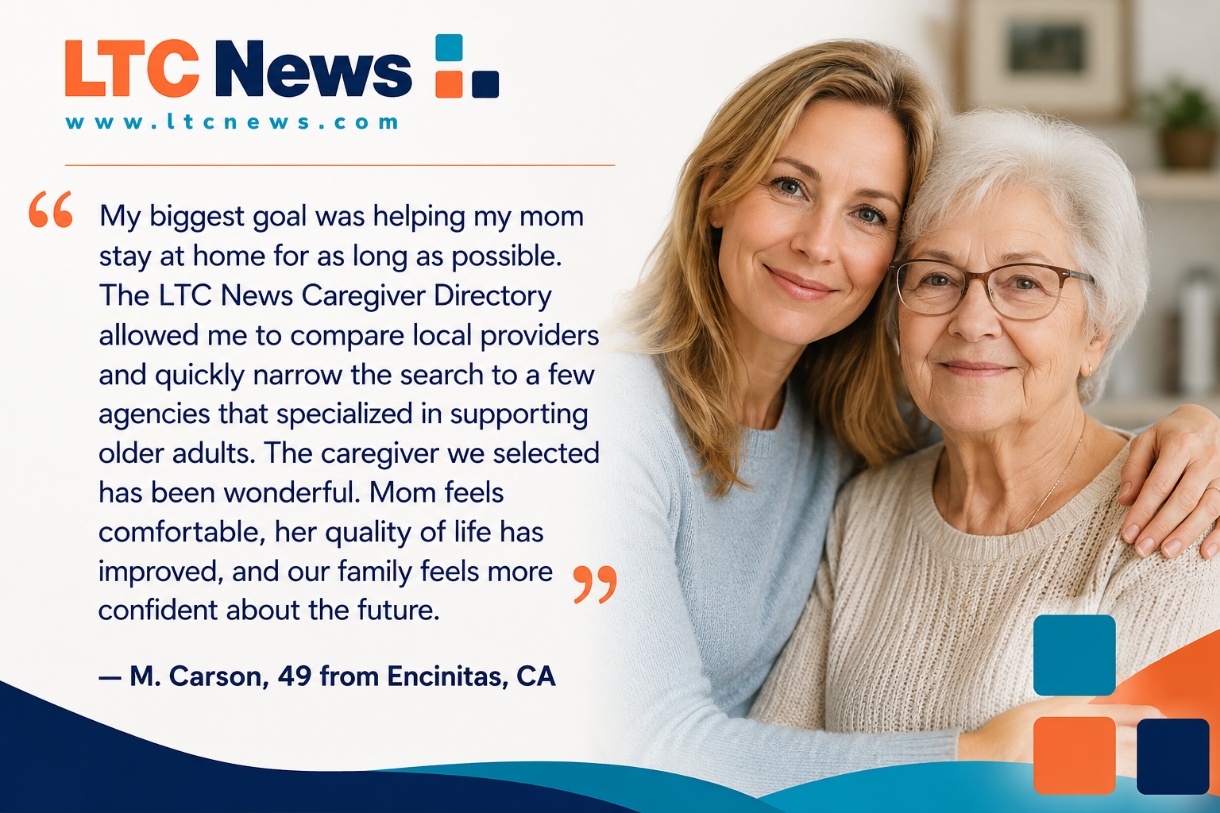
Share your thoughts and experiences about aging, caregiving, health, retirement, and long-term care with LTC News —Contact LTC News.
Dementia Care Requires Additional Evaluation
Families seeking memory care should pay particular attention to staff training, security measures, activity programming, and experience caring for individuals with Alzheimer's disease and related dementias.
As dementia progresses, care needs often become more specialized. Providers with dedicated memory care programs may be better equipped to manage wandering behaviors, communication challenges, medication oversight, and safety concerns.
California's growing dementia population has increased demand for these specialized services, making early planning especially important.
What Families Should Look For
Quality care involves far more than attractive buildings or marketing materials. Start with research. The LTC News Caregiver Directory is a good first step. You can search for caregivers and long-term care facilities based on zip code. Those search results can help you narrow down options for a loved one.
When evaluating providers, families should consider staffing levels, caregiver training, turnover rates, state licensing history, inspection reports, specialization in dementia care, resident engagement programs, and communication practices.
Location also matters. A facility closer to family members often allows more frequent visits and oversight. Research consistently shows that family involvement can improve quality of life and help identify problems before they become serious.
For home care services, families should verify that agencies are properly licensed and insured and that caregivers have undergone background screening and training. California requires licensing and oversight of home care organizations, providing additional consumer protections.
If a loved one has Long-Term Care Insurance, be sure to notify the provider of the policy. Doing so can benefit your loved one; facilities and home health agencies that know they will be paid are more likely to prioritize the applicant on waiting lists.
LTC News has partnered with Amada Senior Care to provide free Long-Term Care Insurance claim support with no cost or obligation. Trained experts are available to guide policyholders through the process to help them access benefits — File a Long-Term Care Insurance Claim.
👉 Making a Long-Term Care Insurance Claim: Is It Difficult?
Are You Prepared?
California's Master Plan for Aging makes clear that the state recognizes the scale of what's coming: more older adults, more dementia diagnoses, more family caregivers stretched thin, and a health care workforce that isn't yet ready for the demand. Those are systemic issues that will take years, possibly decades, to address. What families can control today is their own plan. Quality long-term care, whether at home, in assisted living, or in a memory care community, costs money. The gap between what California seniors need and what Medicare or a future state program might cover is significant.
Long-Term Care Insurance has already proven, to the tune of nearly $17.8 billion in California alone, that it can bridge that gap for families who plan ahead. While you can only do your best for older family members, you can be proactive for yourself and your family. Even a small policy can help ensure you have access to the quality care you choose without burdening those you love.
Frequently Asked Questions
Can everyone qualify for Medi-Cal long-term care benefits?
No. Medi-Cal is not a universal long-term care benefit. Eligibility depends on financial and functional requirements. Many middle-income families are surprised to learn that qualifying for benefits can be more complex than expected.
Why is California so concerned about aging and long-term care?
California is experiencing significant growth in its older adult population. State leaders anticipate increased demand for home care, assisted living, memory care, nursing homes, transportation services and family caregiving support. The California Master Plan for Aging was developed to help prepare for these demographic changes.
Why are long-term care costs higher in California?
Several factors contribute to higher costs, including housing expenses, labor shortages, caregiver wages, regulatory requirements and strong demand for services. Costs are often highest in major metropolitan areas such as San Francisco, Los Angeles and San Diego.
How much does long-term care cost in California?
Costs vary by region and type of care. According to the LTC News Cost of Care Calculator, home health care can exceed $8,400 per month in some California communities, while nursing home care often exceeds $14,000 to $15,000 per month. Future projections suggest costs will continue rising substantially.
Why is California facing caregiver shortages?
Demand for caregivers is growing faster than the available workforce. High housing costs, relatively low wages for direct-care workers and increasing demand for services have made recruiting and retaining caregivers difficult throughout much of the state.
What is Medi-Cal and how does it help with long-term care?
Medi-Cal is California's Medicaid program. It serves as a safety net for eligible individuals who need long-term care services but have limited financial resources. Medi-Cal may help pay for nursing home care and certain home- and community-based services for qualified individuals.
How many Californians are living with Alzheimer's disease?
California has one of the largest populations of people living with Alzheimer's disease and related dementias in the nation. According to research cited in the article, more than 719,000 Californians are currently living with Alzheimer's disease, and the number is expected to rise significantly in the coming years.
Why does dementia create such a major long-term care challenge?
Unlike many medical conditions, dementia often requires years of supervision, support and assistance with daily activities. Family members frequently become caregivers, helping manage medications, finances, transportation and personal care before professional services become necessary.
What is California's Master Plan for Aging?
The California Master Plan for Aging is a statewide initiative designed to improve aging services and help older adults remain independent. The plan focuses on aging in place, caregiver support, workforce development, transportation, housing accessibility, dementia care and reducing social isolation.
Does Medicare pay for long-term care?
Generally, no. Medicare primarily covers short-term skilled care under specific circumstances, such as after a qualifying hospitalization. Medicare does not typically pay for ongoing custodial care, assisted living, memory care or extended home care services.
How much has Long-Term Care Insurance paid California families?
According to America's Health Insurance Plans (AHIP), traditional Long-Term Care Insurance policies paid more than $1.63 billion in benefits to California policyholders in 2024 alone and more than $17.79 billion historically.


Sponsored