Streamlining Compliance: Best PBJ Reporting Automation Solutions for Nursing Homes
About This Article
There are several top PBJ reporting automation solutions for nursing homes, ensuring that staffing levels are consistent throughout the year. Learn how automated payroll-based journal tracking improves CMS compliance, boosts Five-Star ratings, and enhances care transparency for families and residents.

Jacob Thomas
Jacob Thomas writes on health, wellness, and retirement topics, including aging, caregiving, insurance, and long-term care.
Payroll-Based Journal (PBJ) reporting requirements are essential because they track direct care staffing hours and help ensure transparency and compliance in senior care settings. When done manually, PBJ reporting can lead to errors, missing data, and unnecessary stress. That is why more nursing homes are turning to automated solutions that simplify the process and reduce administrative burden.
To provide a deeper look into Payroll-Based Journal (PBJ) reporting, it is helpful to view it not just as a regulatory hurdle but also as a mechanism for quality control. Since the Centers for Medicare & Medicaid Services (CMS) began requiring this data under the Affordable Care Act, it has fundamentally changed how the public and the government evaluate nursing homes.
Here is an expansion of what PBJ reporting is and how its accuracy (or lack thereof) ripples through the entire long-term care ecosystem.
What is Payroll-Based Journal (PBJ) Reporting?
PBJ reporting is the mandatory, electronic submission of staffing data by skilled nursing facilities (SNFs) to CMS. This includes:
- Direct Care Hours: Actual hours worked by registered nurses (RNs), licensed practical nurses (LPNs), and certified nursing assistants (CNAs).
- Staffing Levels: Data on both facility employees and agency/contract staff.
- Turnover and Tenure: Information that tracks how long employees stay at a facility.
Unlike the old "snapshot" method, which relied on self-reported data during annual inspections, PBJ is auditable and ongoing, ensuring that staffing levels are consistent throughout the year, not just when inspectors are in the building.
Impact on Long-Term Care Facilities
For providers, PBJ reporting is the "report card" that determines their professional standing and financial viability.
- Five-Star Quality Ratings: Staffing data is a primary component of the CMS Five-Star Quality Rating System. Lower staffing hours directly lead to fewer stars, which can result in lower census and reduced referrals.
- Audit Risks and Penalties: Inaccurate or late submissions can trigger audits or lead to a facility's staffing rating being suppressed to one star.
- Operational Intelligence: Automated PBJ tools give administrators real-time visibility into labor costs and staffing gaps, allowing them to adjust schedules before they fall out of compliance.
Impact on Residents
Staffing is the single most significant predictor of resident outcomes. PBJ reporting creates a direct incentive for facilities to maintain safe ratios.
- Clinical Outcomes: Higher staffing levels, as verified by PBJ data, are consistently linked to lower rates of pressure ulcers, falls, and medication errors.
- Acuity-Based Care: When reporting is accurate, it ensures that the "acuity" (the intensity of care needed) of the resident population matches the number of nurses on the floor.
- Dignity and Responsiveness: Proper staffing means shorter wait times for call lights and more personalized attention for daily activities like bathing and dining.
Impact on Families
For families, PBJ data acts as a tool for empowerment and peace of mind during a difficult decision-making process.
- Transparency and Trust: Families use the Medicare Care Compare website to vet facilities. PBJ data provides the "truth in advertising" that allows families to see if a facility is actually staffed as well as its marketing materials claim.
- Accountability: Knowing that staffing is being monitored by the federal government gives families a formal avenue to address concerns if they feel their loved one isn't receiving enough attention.
- Informed Advocacy: If a family member notices a decline in care, they can look at the facility's public staffing trends to see if there is a systemic issue with turnover or nurse-to-resident ratios.
Role of Automation
Moving from manual spreadsheets to automated payroll-to-PBJ systems isn't just about saving time for the HR department—it’s about data integrity. Automated systems flag "ghost" hours or missing data in real-time, ensuring that the facility's public rating reflects the actual care being provided on the floor. This protects the facility’s reputation while ensuring residents and families have an accurate picture of the care environment.
Leading PBJ Reporting Automation Solutions for Nursing Homes
These systems are commonly used in senior care environments for PBJ reporting, workforce tracking, and compliance automation. Each solution offers a different approach based on a facility's size, staffing complexity, and integration needs.
1. Smartlinx
SmartLinx is a workforce management platform built specifically for senior care organizations, with a strong focus on automating compliance-intensive processes such as PBJ reporting. It has been widely adopted across various long-term care and skilled nursing facilities.
Key Features
- Real-time workforce data synchronization across scheduling, time tracking, and payroll systems.
- Automated PBJ file generation aligned with Centers for Medicare & Medicaid Services (CMS) submission requirements.
- Exception alerts that flag missing or inconsistent staffing entries before submission.
- Centralized compliance dashboard that helps monitor staffing levels across multiple facilities.
What sets SmartLinx apart is its real-time data integration tailored for senior care providers. This helps ensure that PBJ submissions reflect accurate, up-to-date staffing information without requiring manual reconciliation.
2. StaffScheduleCare
StaffScheduleCare is designed with a strong emphasis on scheduling efficiency for long-term care environments. It is primarily used by nursing homes that want tighter control over shift planning and staff allocation while supporting more accurate PBJ reporting automation.
Key Features
- Shift-fill automation tools that prioritize qualified caregivers based on certification and availability.
- Built-in compliance rules that prevent scheduling violations before they occur.
- Staff self-service portal for shift swapping and availability updates.
- Customizable reporting tools for staffing audits and internal reviews.
The company’s strength lies in preventing staffing issues before they happen, reducing the likelihood of compliance problems during PBJ reporting periods.
3. ShiftWizard by HealthStream
ShiftWizard is a workforce scheduling platform developed by HealthStream, a company known for its broader suite of workforce and training solutions in senior care and clinical environments. It is commonly used in nursing homes to improve workforce visibility and align staffing decisions with resident needs.
Key Features
- Real-time staffing census tracking to align staffing levels with resident needs.
- Predictive staffing models that help forecast peak care demand periods.
- Mobile shift management tools for caregivers working across units or facilities.
- Integration with clinical training systems to align staffing with competency requirements.
ShiftWizard is particularly helpful for facilities that want staffing decisions to reflect both care demand and caregiver qualifications while ensuring the underlying staffing data supports reliable PBJ reporting.
4. OnShift
OnShift focuses on workforce management specifically for senior living and post-acute care environments. It is widely used for its emphasis on staffing stability and retention, as well as its compliance support.
Key Features
- Labor cost forecasting tools are tied directly to staffing schedules.
- Engagement tools like shift incentives to reduce last-minute callouts.
- Compliance tracking features that align staffing hours with regulatory reporting needs.
- Built-in hiring and onboarding workflows designed for high-turnover environments.
OnShift is often chosen by facilities that struggle with caregiver retention and need tools that connect staffing decisions with workforce stability.
5. Viventium
Viventium is a payroll and HR platform widely used in senior care settings, particularly home care and nursing facilities that want tighter payroll-to-staffing alignment for compliance reporting. It helps ensure that data used for PBJ submissions is consistent, accurate, and audit-ready.
Key Features
- Payroll processing is tied directly to time-and-attendance records for cleaner reporting.
- Audit-ready payroll reports that simplify PBJ data validation.
- Role-based access controls that limit sensitive staffing data exposure.
- Error-checking tools that identify mismatches between scheduled and worked hours.
Viventium is especially useful when PBJ reporting challenges are closely tied to payroll accuracy and time-tracking consistency.
How These Solutions Were Evaluated
To help compare these platforms fairly and practically, the focus was placed on the following elements:
- How accurately does the platform capture and organize staffing time for PBJ submission?
- The level of automation in generating and validating PBJ reports.
- How easily the system integrates with scheduling, payroll, and timekeeping tools.
- Whether the solution is purpose-built for senior care settings rather than general HR software.
- How well it reduces manual administrative work and reporting errors.
- Support for multifacility visibility and compliance oversight.
These criteria matter because PBJ reporting is a mandatory requirement for Medicare- and Medicaid-certified nursing facilities. CMS requires electronically submitted standardized staffing data, including direct care hours and employee roles, to ensure transparency and compliance.
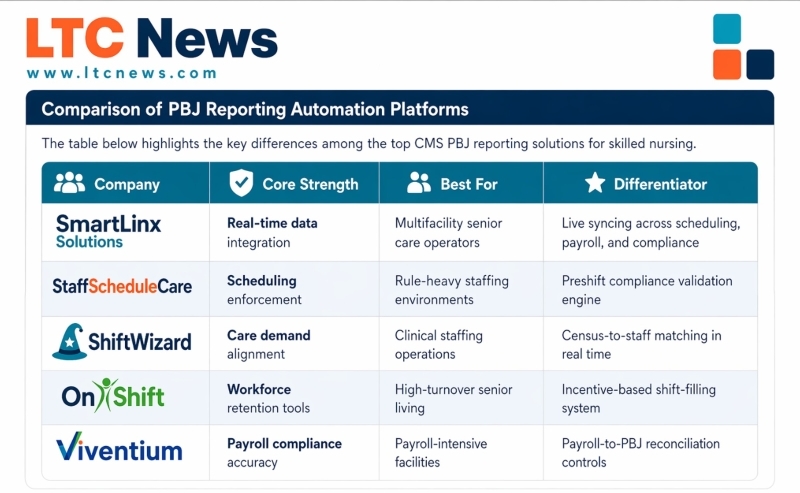
Comparison of PBJ Reporting Automation Platforms
The table below highlights the key differences among the top CMS PBJ reporting solutions for skilled nursing.
Choosing the Right PBJ Automation Approach
Choosing the best PBJ reporting software for nursing homes depends on where the biggest operational challenges lie. If a facility struggles with disconnected systems and delayed data, platforms like SmartLinx stand out due to their real-time integration across scheduling, payroll, and compliance workflows.
For facilities facing staffing instability or turnover, OnShift provides tools that address shift coverage gaps. Payroll-focused environments often benefit from Viventium’s reconciliation and audit-ready reporting structure.
Ultimately, the best solution is the one that reduces manual work while improving accuracy, allowing providers to stay compliant without adding stress to demanding senior care operations.
Prioritizing Care Through Compliance
The transition from manual tracking to automated PBJ reporting is more than a technical upgrade; it is a strategic commitment to quality and transparency. In an era where staffing levels are under intense scrutiny by CMS, residents, and their families, the "set it and forget it" reliability of automated systems is invaluable.
By choosing a solution that aligns with your specific operational hurdles, whether that is payroll reconciliation, scheduling complexity, or caregiver retention—facilities can shift their focus back to what matters most: providing exceptional, dignified care to the seniors who call these communities home.
Connecting Families with Care: The LTC News Caregiver Directory
Finding the right care solution can be an overwhelming journey for families. Currently, thousands of families across the country are actively searching for quality in-home caregivers and long-term care facilities that they can trust. To simplify this process, many are turning to the LTC News Caregiver Directory, a comprehensive resource designed to bridge the gap between those who need care and those who provide it.
A Localized Search for Peace of Mind
The directory allows families to filter their search by town or ZIP code, making it easy to find the best local options for their loved ones. By providing a transparent look at available services, the directory empowers families to make informed decisions based on proximity, specific care needs, and service quality.
Opportunities for Providers
If you manage a long-term care facility or a home health agency, being visible where families are searching is critical. The LTC News Directory Business Portal offers tools to help you connect with these families effectively:
- Claim Your Free Listing: Ensure your facility or agency is represented in the directory at no cost. This provides a baseline presence in a high-traffic area for care seekers.
- Upgrade for Maximum Visibility: Providers can choose to upgrade their listings to stand out from the competition. An enhanced listing allows you to: Highlight your specialized staff and unique services, showcase your facility’s culture and amenities, and improve your ranking in local search results.
By leveraging the LTC News Caregiver Directory, providers can ensure they are seen by the families who need them most, while families gain a reliable tool to navigate the complexities of long-term care.
Frequently Asked Questions
How often must PBJ data be submitted to CMS?
Facilities are required to submit staffing data on a quarterly basis. Submissions are due no later than 45 days after the last day of each fiscal quarter. Missing a deadline can result in a facility's staffing rating being automatically reduced to one star on the Care Compare website.
Does PBJ reporting include non-clinical staff?
While the primary focus is on direct care staff (RNs, LPNs, CNAs, and therapists), CMS also requires reporting for certain administrative and service roles that impact resident care. However, the staffing star rating is calculated specifically based on nurse staffing hours per resident day.
Can small facilities benefit from automation?
Absolutely. While large multi-facility operators use automation for oversight, small facilities benefit significantly from the reduction in administrative hours. Automation ensures that a small team isn't bogged down by manual data entry, preventing the "unnecessary stress" and human error common in manual reporting.
How does PBJ reporting track agency or contract staff?
Contract staff must be included in PBJ submissions. Automated platforms simplify this by allowing facilities to track agency hours separately but aggregate them into the final CMS-ready file, ensuring that the total care provided to residents is accurately represented.
What happens if a facility submits inaccurate data?
CMS conducts regular audits of PBJ data. If a facility cannot verify the hours submitted through payroll records or other documentation, it may face staffing rating suppressions, increased survey scrutiny, or civil money penalties.
Is PBJ data available to the public?
Yes. The data submitted through the Payroll-Based Journal system is processed and published on the Medicare Care Compare website. This allows families, researchers, and advocacy groups to monitor staffing trends and compare facilities based on verified data rather than self-reported claims.

Sponsored