Physician Oversight in Home Health Care: What You Must Know Before Hiring Care

About This Article
Physician oversight in home health care ensures clinical accountability, safe care protocols, and proper response to medical changes. Without it, older adults face higher risks of medical errors, untreated complications, and gaps in care—making provider evaluation essential before hiring.

Linda Kople
Linda Kople is a freelance writer focused on caregiving, aging, health, wellness, long-term care, and retirement planning
Table of Contents
- What Physician Oversight Means—and Why It Exists
- Why Oversight Becomes Critical as You Age
- Growth of Nurse-Led Care—Opportunity and Risk
- Questions You Should Always Ask a Care Provider
- How to Check a Provider’s Record (Few Families Do This)
- Why This Matters for Your Long-Term Care Plan
- Who Is Responsible?
- Action Items
You’re not just choosing a service, but you’re making decisions for someone who once made them for you. That can be mind-blowing when it happens, but you know you have the responsibility. Often, there was little conversation or planning about aging and long-term care, but you are here now.
You compare care providers. You look at schedules, costs, and availability. You're probably surprised that Medicare doesn't cover the cost of long-term care services, except for limited skilled services. You may even meet the caregiver who will be in your parents’ home.
But there’s a deeper question most families don’t ask early enough: Who is medically responsible for your parent’s care once services begin?
Because when your loved one's care requires more than just basic custodial services, when it involves medications, chronic illness, recovery, or cognitive decline, you’re no longer just hiring help. You’re stepping into a more complicated environment.
And if there isn’t a clear physician oversight structure behind that care, responsibility becomes blurred. Decisions get delayed. Risks increase. That’s the part you don’t see—but it’s often what matters most.
Families who want to evaluate a care provider thoroughly should ask about the oversight structure. Providers who use healthcare consulting and medical oversight services have typically invested in building a compliant, physician-backed clinical framework. That matters when care needs become more complex.
What Physician Oversight Means—and Why It Exists
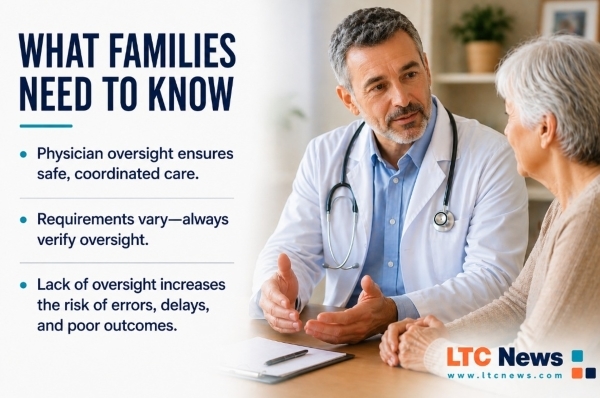
Physician oversight is the clinical framework that holds home health care together. It ensures your parent’s extended care is not just compassionate but also medically appropriate, coordinated, and accountable.
Under Centers for Medicare & Medicaid Services (CMS) regulations, Medicare-certified home health agencies must operate under a physician-directed model.
That includes:
- Certification that care is medically necessary
- A physician-approved plan of care
- Ongoing review and updates as conditions change
You can also review provider quality ratings using Medicare’s Care Compare tool.
These aren’t administrative steps. They are safeguards designed to protect your parent when care becomes more complex.
In practice, strong oversight means:
- Care follows medically approved protocols—not guesswork
- Staff stay within defined clinical boundaries
- Changes in condition trigger physician involvement
- There is clear accountability if something goes wrong
Without that structure, families often assume someone is “in charge”—when in reality, no one clearly is.
Why Oversight Becomes Critical as You Age
As your parent ages, care rarely stays simple. The U.S. Department of Health and Human Services says more than half of us who reach the age of 65 will need long-term care services. While most long-term care remains custodial, some intermediate or skilled care is required by many people as they age,
That often means managing:
- Multiple chronic conditions
- Several medications
- Increased fall risk
- Slower recovery from illness or injury
At the same time, much of that responsibility falls on families.
More than 63 million Americans now provide unpaid care for a loved one, a 45% increase since 2015. Many are adult children balancing careers, distance, and caregiving responsibilities without clinical training. Perhaps you are experiencing this right now.
When a loved one needs some skilled service, in addition to help with daily living activities, physician oversight becomes essential. Without it, you may find yourself:
- Trying to interpret symptoms or changes in condition
- Unsure when to escalate a concern
- Relying on caregivers who may not be authorized to act
With it, your parent’s care becomes structured:
- There is a defined plan guiding decisions
- Changes in condition are reviewed clinically
- Care evolves as needs increase
That structure reduces uncertainty—for both you and your parent.
Growth of Nurse-Led Care—Opportunity and Risk
The home care landscape in 2026 offers more choices than ever.
You may be evaluating:
- Concierge nursing services
- Telehealth-based care
- IV hydration clinics
- Independent nurse practitioner practices
For families, these options can be valuable. They often allow your parent to stay at home longer and avoid institutional care. But not all providers operate with the same clinical structure.
In most states, nurse-led clinical services require physician collaboration or oversight. The depth of that relationship varies—and that difference matters.
A well-structured provider will:
- Clearly identify the supervising physician
- Use approved clinical protocols
- Maintain documentation and compliance
- Provide a clear escalation process
Others may offer similar services—but without the same level of oversight or accountability. From the outside, they can look identical. Internally, they are not.
Questions You Should Always Ask a Care Provider
Before hiring any home health or clinical provider, ask:
- Who is the supervising or collaborating physician?
- Is that physician licensed in your state?
- How are care protocols approved and reviewed?
- What happens if there is a sudden health change?
- Can you provide documentation of oversight?
Clear answers signal a strong provider. Vague answers are a warning sign.
How to Check a Provider’s Record (Few Families Do This)
Most families rely on referrals or online reviews when choosing care.That’s understandable—but incomplete. You can—and should—verify a provider independently.
Start with:
- Searching for providers on the LTC News Caregiver Directory
- Medicare Care Compare
- State health department records
- Professional licensing boards
These sources can reveal:
- Complaint patterns
- Inspection findings
- Licensing status
The Administration for Community Living supports Long-Term Care Ombudsman programs that help families evaluate providers and understand their rights.
One more step many families skip: ask the provider directly about their compliance history. A strong provider will answer clearly—and provide documentation.
If they hesitate, that tells you something. Spending a small amount of time verifying a provider can prevent serious problems later.
Why This Matters for Your Long-Term Care Plan
Most long-term care starts at home—and becomes more complex over time. At the same time:
- Medicare only covers short-term skilled care—up to 100 days—and only if strict eligibility requirements are met, including a qualifying hospital stay
- It does not cover ongoing custodial care
- Families often face significant out-of-pocket costs
This is where planning becomes essential. Using the LTC News Cost of Long-Term Care Services Calculator, you can:
- See real-time and projected extended care costs in your area
- Compare home care and facility options
- Additional tools and resources
Long-Term Care Insurance provides additional protection if you or a loved one has an LTC Insurance policy before you need extended care:
- Benefits are tax-free
- Coverage often begins with care at home, but you choose
- You gain access to quality caregivers and facilities
- It reduces reliance on untrained family caregivers
Without a plan, families are often forced into reactive decisions during a crisis.
Learn More: LTC News Long-Term Care Learning Center
Who Is Responsible?
Too many people make assumptions that long-term care is like anything else. However, long-term care is an individual responsibility, and you’re not just hiring help, but you’re building a care system around someone you love.
So ask yourself: Do you know who is medically responsible for the care being delivered in your parent’s home? Is there a plan in place now? Have you thought about what happens when you need long-term care in the future?
If the answer isn’t clear, don’t move forward yet.
Most people acquire Long-Term Care Insurance between the ages of 47 and 67 as part of a comprehensive retirement plan. Get accurate quotes from a qualified Long-Term Care Insurance specialist.
Action Items
If you’re evaluating care options, the LTC News Caregiver Directory can help you find qualified providers nationwide. If a loved one already has a Long-Term Care Insurance policy:
- Notify the provider early
- Ask about home care benefits first
- Start the claims process as soon as care begins
LTC News also partners with Amada Senior Care, which can help you navigate claims at no cost or obligation. Their trained experts can walk you through the entire process and help you access benefits quickly and correctly — File a Long-Term Care Insurance Claim.
Taking these steps now can protect your family later. Every provider you consider will tell you they care.
Many will look qualified. Some will feel like the right fit. But the difference between safe, coordinated care and avoidable problems often comes down to one thing: Is there a real clinical structure behind the care—or not?
If no physician is clearly overseeing your parent’s care, then critical decisions may fall to people who are not trained—or not authorized—to make them. That’s when small issues become emergencies. That’s when families are forced to react instead of plan.
You don’t need to be a medical expert to protect your parent. But you do need to ask the right question before you hire: Who is medically responsible—and how are they involved?
If you can’t get a clear, documented answer, keep looking. Because the quality of that answer will shape the quality—and safety—of your parent’s care moving forward.
Frequently Asked Questions
How does physician oversight impact long-term care planning?
Physician oversight plays a key role in long-term care planning because it ensures that care is medically appropriate as needs increase over time. As care evolves from basic assistance to more complex services, having a structured clinical framework helps prevent gaps, reduce risk, and improve overall outcomes.
Why is physician oversight important for older adults?
Physician oversight is critical because older adults often have multiple health conditions, medications, and a higher risk of complications. Without proper medical supervision, issues like medication errors, untreated symptoms, or delayed responses to health changes can occur. Oversight ensures care is coordinated and adjusted as needs evolve.
Are nurse practitioners allowed to provide care without a physician?
It depends on the state. Some states allow nurse practitioners to practice independently, while others require physician collaboration or supervision. Even in independent practice states, many high-quality providers still maintain physician oversight to ensure strong clinical structure and accountability.
How can you verify if a provider has proper physician oversight?
You can verify oversight by:
- Asking the provider to identify their supervising physician
- Requesting documentation of the oversight agreement
- Checking provider ratings on Medicare Care Compare
- Reviewing state licensing and inspection records
You can also search providers using the LTC News Caregiver Directory to find qualified care options.
Does Medicare cover home health care with physician oversight?
Yes, but only under specific conditions. Medicare covers short-term skilled home health care—up to 100 days—and only if strict eligibility requirements are met, including a qualifying hospital stay and physician certification of medical necessity. It does not cover ongoing custodial care.
How does Long-Term Care Insurance help with home care services?
Long-Term Care Insurance helps pay for extended care services that Medicare does not cover, including care at home. Benefits are typically tax-free and can provide access to higher-quality providers, including those with proper physician oversight. This reduces financial strain and helps families avoid relying solely on unpaid caregivers.
What is physician oversight in home health care?
Physician oversight means a licensed doctor is responsible for approving, reviewing, and guiding a patient’s care plan. In home health care, this includes certifying medical necessity, establishing treatment protocols, and monitoring changes in condition to ensure care remains safe and appropriate.
Is physician oversight required for all home care providers?
No. Physician oversight is required for Medicare-certified home health agencies under federal rules, but private-pay providers and some nurse-led services may operate under different standards depending on state laws. That’s why it’s important to ask each provider directly about their oversight structure.
What are the most important questions to ask before hiring a home care provider?
Before hiring a provider, ask:
- Who is the supervising or collaborating physician?
- How are care plans created and reviewed?
- What happens in a medical emergency or sudden change?
- Can you provide documentation of oversight?
Clear, documented answers help ensure your loved one receives safe, well-managed care.
What happens if a home care provider does not have physician oversight?
Without physician oversight, there may be no clear medical authority guiding care decisions. This can lead to:
- Delayed response to health changes
- Care outside a caregiver’s training or scope
- Lack of accountability if something goes wrong
This increases the risk of poor outcomes, especially when care becomes more complex.


Sponsored