How to Find the Right Memory Care for a Loved One Practical Guide to Choosing Safe, Compassionate Dementia Care

About This Article
Finding memory care is emotional and complex. Learn how to evaluate communities, understand costs, compare state differences, and use insurance or other assets to pay for quality care.

Linda Kople
Linda Kople is a freelance writer focused on caregiving, aging, health, wellness, long-term care, and retirement planning
Table of Contents
- What Memory Care Is—and Why It Matters
- Start With a Clear Clinical and Safety Assessment
- Memory Care vs. Staying at Home: What Families Need to Understand
- Why Environment Matters More Than You Think
- What Defines a High-Quality Memory Care Community?
- How to Evaluate Memory Care Communities
- Activities and Engagement: More Than Just “Keeping Busy”
- Communication With Families
- Memory Care Tour Checklist
- Spotlight: Oregon vs. Tennessee — Aging, Dementia Risk, and Memory Care Costs
- Population Age 65+: Comparing the Demographics
- Dementia and Alzheimer’s Risk
- Cost of Memory Care and Long-Term Care
- Planning Considerations
- Finding Quality Memory Care
- Need Help Filing an LTC Insurance Claim?
- Take Action Before a Crisis Forces the Decision
It’s a heavy realization when the roles start to shift, and that initial spark of worry turns into a constant weight in your chest. Your opening captures the progression well, but we can deepen the emotional resonance by focusing more on the bond between the caregiver and their loved one, rather than just the clinical symptoms.
It starts with a misplaced key or a story told twice, moments you easily brush off as "just getting older." But then comes the day the familiar map in their mind simply fades. You see the flicker of frustration in their eyes—a brief, heartbreaking lapse where home doesn’t feel like home anymore.
Suddenly, the love you’ve always shared is shadowed by a new, heavy responsibility: the realization that their world is shrinking, and you can no longer bridge the gap alone. Memory care isn't about giving up; it’s about finding a place where their dignity is guarded as fiercely as you guard their safety.
The reality is, even if a loved one is still independent, thinking about the consequences of aging is essential, as 56% of seniors who reach the age of 65 will need some form of extended care, including memory care.
An estimated 7.4 million Americans aged 65 and older are living with clinical Alzheimer’s dementia, according to the Alzheimer's Association report for 2026. Total annual costs of caring for people living with Alzheimer’s and other dementias (excluding unpaid care) will reach $409 billion in 2026. While some of this is paid for by Long-Term Care Insurance and Medicaid (for those with little or no income and assets), most of that cost is paid for by families.
The Trend: This represents a $25 billion increase from 2025. Projections suggest this will hit nearly $1 trillion by 2050 (in today's dollars).
What Memory Care Is—and Why It Matters
Memory care is specialized long-term care designed for people living with Alzheimer’s disease or other forms of dementia. It provides a structured, secure setting with staff trained to manage cognitive decline and behavioral changes.
Care is typically adjusted over time, with higher levels of supervision and assistance as cognitive decline progresses. Unlike traditional assisted living, memory care focuses on:
- Reducing confusion and overstimulation
- Preventing wandering and injury
- Maintaining structured daily routines
- Supporting emotional and cognitive health
As dementia progresses, these elements become essential for both safety and quality of life.
Start With a Clear Clinical and Safety Assessment
Before you tour a single memory care community, you need an honest, detailed understanding of your loved one’s condition. Dementia is progressive. What feels manageable today may not be safe in six months.
Living in a dementia-friendly environment is important to delay or prevent cognitive decline. — Suhang Song, assistant professor of health policy and management at the University of Georgia.
Focus on three core areas:
Cognitive and Behavioral Changes
- Repeating questions or stories
- Poor judgment (leaving the stove on, falling for scams)
- Confusion about time or place
- Anxiety, agitation, or paranoia
Physical and Functional Needs (ADLs)
- Bathing and grooming
- Dressing
- Toileting and continence
- Mobility and fall risk
Safety Risks
- Wandering or getting lost
- Medication mismanagement
- Leaving appliances on or doors unlocked
A physician, often a neurologist or geriatric specialist, should evaluate your loved one and help determine the appropriate level of care.
Early planning gives families more choices and reduces the likelihood of crisis-driven decisions. — Alzheimer’s Association.
Memory Care vs. Staying at Home: What Families Need to Understand
Most families try to keep a loved one at home first. It feels familiar and personal. And in the early stages, it can work. But dementia does not stay static. As the condition progresses, home care often requires:
- Multiple caregivers rotating shifts
- Overnight supervision
- Increasing medical oversight
- Home modifications for safety
Costs can escalate quickly and, in many cases, rival or exceed memory care. More importantly, safety becomes harder to guarantee.
Ask yourself: if they were alone tonight, would you feel confident they’re safe?
Also consider:
- Are they safe alone for even a few hours?
- Are you sleeping through the night—or staying alert?
- Is caregiving affecting your own health?
Across the United States, more than 63 million Americans now provide unpaid care, a 45% increase since 2015, according to data reviewed by LTC News. Memory care is not about replacing family care; it’s about adding structure, safety, and professional oversight when it becomes necessary.
Why Environment Matters More Than You Think
People living with dementia are highly sensitive to their surroundings. Busy or chaotic environments can increase anxiety and confusion. Calm, structured settings can reduce agitation and improve daily function.
People with dementia often show increased reactivity to even mild stimuli, which may explain agitation triggered by environmental factors such as noise, lighting, or unfamiliar surroundings. — neurologist Caterina Carrarin, Department of Neuroscience, Imaging and Clinical Sciences at Gabriele d’Annunzio University in Italy.
As noted in your source material, peaceful environments—especially those with access to nature—can:
- Reduce stress and restlessness
- Improve mood and emotional stability
- Support better sleep and routines
- Encourage gentle physical activity
When touring communities, pay attention to how the environment feels—not just how it looks.
What Defines a High-Quality Memory Care Community?
Not all communities provide the same level of care. High-quality memory care typically includes:
- Consistent staffing with low turnover
- Individualized care plans tailored to cognitive ability
- Secure but non-restrictive environments
- Ongoing staff training in dementia care
- Meaningful daily engagement programs
You should also review state inspection reports and ask about any recent violations.
How to Evaluate Memory Care Communities
Staff Training and Compassion
The quality of care starts with the people.
Ask:
- What dementia-specific training do caregivers receive?
- How often is training updated?
- What is the staff-to-resident ratio?
- Is medical staff available on-site?
Observe interactions closely. Respect, patience, and engagement are clear indicators of quality care.
Safety and Design
Memory care communities should be purpose-built.
Look for:
- Secured entrances and exits
- Simple, easy-to-navigate layouts
- Visual cues such as color-coded areas
- Enclosed outdoor spaces
- Fall-prevention features
These elements reduce confusion and help residents maintain independence longer.
Activities and Engagement: More Than Just “Keeping Busy”
In memory care, activities are therapeutic—not optional. Without engagement, individuals with dementia may experience faster decline and increased agitation.
Look for:
Cognitive Activities
- Reminiscence therapy
- Memory-based games adapted to ability
Physical Movement
- Walking programs
- Chair exercises
Sensory Engagement
- Music therapy
- Art and tactile activities
Social Interaction
- Small group programs
- One-on-one engagement
Ask to observe activities in progress. Engagement levels will tell you more than any brochure.
Communication With Families
You are choosing a long-term partner in your loved one’s care.
Evaluate:
- Transparency about care plans and costs
- Responsiveness to questions
- Frequency of updates
Strong communication builds trust and ensures better outcomes.
Memory Care Tour Checklist
Bring this checklist when visiting communities:
- Cleanliness and environment
- Staff interaction with residents
- Noise level and overall atmosphere
- Safety features and layout
- Activity participation
- Dining experience
Trust what you see—not just what you’re told.
Spotlight: Oregon vs. Tennessee — Aging, Dementia Risk, and Memory Care Costs
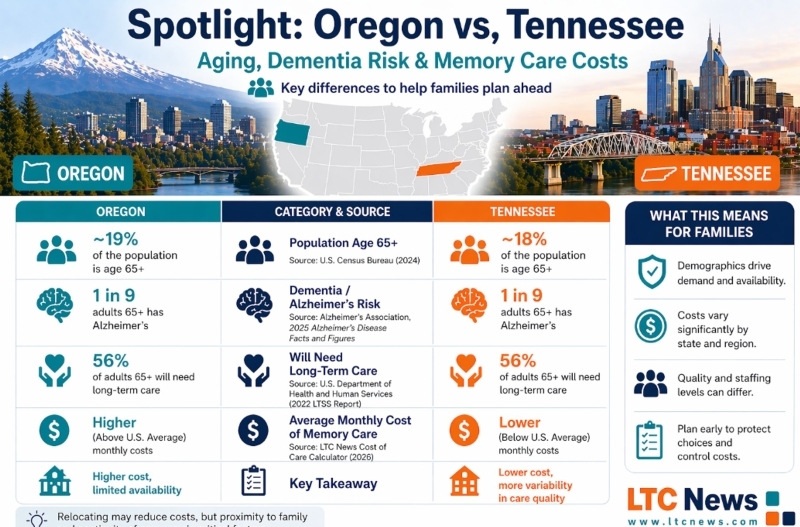
Where your loved one lives can significantly impact both the cost, availability, and quality of memory care—often more than families expect. For many families, these differences only become clear during a crisis, when options are limited and decisions must be made quickly.
Population Age 65+: Comparing the Demographics
Oregon: Older Population, Higher Concentration of Need
- Approximately 19 percent of Oregon’s population is age 65 and older, according to the U.S. Census Bureau
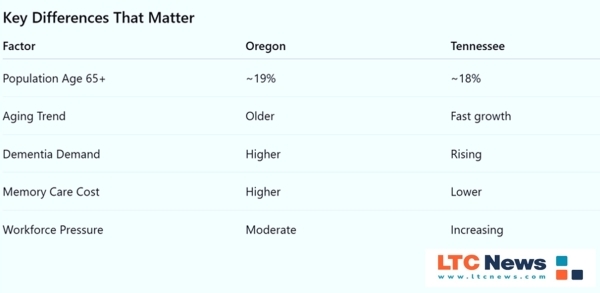
- Higher concentration of older residents increases demand for extended care
Tennessee: Rapid Growth in Older Adults
- Roughly 18 percent of Tennessee’s population is age 65+, according to the U.S. Census Bureau
- Senior population is growing quickly
Dementia and Alzheimer’s Risk
- According to the Alzheimer’s Association, about 1 in 9 Americans age 65 and older is living with Alzheimer’s disease
- The U.S. Department of Health and Human Services reports that approximately 56% of adults age 65 and older will require long-term care that meets the federal definition
As the population ages, the demand for specialized dementia care will continue to grow, placing increasing pressure on families and care systems. — Alzheimer’s Association.
Cost of Memory Care and Long-Term Care
Oregon: Higher Costs and Strong Demand
According to the LTC News survey of long-term care costs, "Cost of Care Calculator (2026)", Oregon—especially metro areas—tends to have above-average memory care costs, driven by:
- Higher labor and regulatory costs
- Strong demand
- Limited availability
The average base cost in 2026 for a memory care facility in Oregon is $6,326 a month, plus surcharges. However, the average cost in Portland, for example, is now $6,913 a month, plus surcharges. The projected cost in Portland in 20 years is expected to be $11,800 per month, plus surcharges.
Search for the current and projected costs where you or a loved one lives in Oregon by using the zip code or city name — Oregon Cost of Care Calculator.
Tennessee: More Affordable but Variable
Tennessee generally offers lower average costs, reflecting:
- Lower cost of living
- Greater variation in care quality and staffing
The average base cost in 2026 for a memory care facility in Tennessee is $5,318 a month, plus surcharges. However, the average cost in Nashville, for example, is now $5,576 a month, plus surcharges. The projected cost in Portland in 20 years is expected to be $9,500 per month, plus surcharges.
Search for the current and projected costs where you or a loved one lives in Tennessee by using the zip code or city name — Tennessee Cost of Care Calculator.
Long-Term Care Insurance is paying for much of these costs in both states. In the latest reporting year, 2024, AHIP reports that $172,294,000 was paid by traditional Long-Term Care Insurance policies in Oregon. $2,130,845,410 were paid by LTC Insurance since policies were first sold in the state.
Tennessee has a similar story. In the latest reporting year, 2024, $281,768,020 was paid by traditional Long-Term Care Insurance policies. $3,446,172,190 were paid by LTC Insurance since policies were first sold in Tennessee.
Planning Considerations
- Oregon: Higher cost, tighter availability
- Tennessee: Lower cost, more variability
Some families consider relocating for cost reasons, but proximity to family and continuity of care remain critical factors.
Finding Quality Memory Care
Memory care costs vary widely depending on location and level of care. According to the LTC News survey of long-term care costs, many communities have higher average costs. Costs often increase over time as care needs become more intensive.
How to Find Trusted Providers
The LTC News Caregiver Directory helps you:
- Find vetted memory care communities
- Compare services and costs
- Locate providers near you
You can compare those search results with communities if there is flexibility. For example, memory care in Salem, OR, will have different costs and options than other areas of the state.
Using Long-Term Care Insurance: Don’t Leave Benefits Untapped
If your loved one has a Long-Term Care Insurance policy, this is the time to use it.
You should:
- Tell the admissions director immediately
- Provide policy details
- Ask about claim coordination
Most policies cover memory care and in-home care, allowing you to start care at home.
Need Help Filing an LTC Insurance Claim?
LTC News partners with Amada Senior Care to provide free assistance in processing a claim for any Long-Term Care Insurance policy.
No LTC Policy? Other Ways to Pay
You may be able to sell an existing life insurance policy for a lump sum to pay for care. This option is often used when someone does not have Long-Term Care Insurance, and care is needed immediately.
What Medicare Does Not Cover
- Medicare covers only short-term skilled care
- It does not cover long-term custodial care, including dementia supervision
When It’s Time to Make the Move
Watch for:
- Safety risks
- Wandering
- Missed medications
- Caregiver burnout
Early planning leads to better outcomes.
Take Action Before a Crisis Forces the Decision
Understand the emotional reality. You may feel guilt. That’s normal. Choosing memory care is about safety, dignity, and proper care.
If your older family members are still independent, now is the time to talk about long-term care planning. Most people purchase Long-Term Care Insurance between the ages of 47 and 67, but older adults may still qualify depending on their health. Speaking with a qualified Long-Term Care Insurance specialist is the first step—whether you’re helping a loved one plan or preparing for your own future.
Talk with your family now.
Finding quality memory care is not just about choosing a facility—it’s about ensuring safety, preserving dignity, and planning for the future. The earlier you start, the more control you have over the outcome.
Frequently Asked Questions
Why does environment matter in memory care?
People living with dementia are highly sensitive to their surroundings. Calm, structured environments can:
- Reduce anxiety and agitation
- Improve sleep and emotional stability
- Encourage engagement in daily activities
Busy or chaotic settings can increase confusion and behavioral symptoms.
Does Medicare or health insurance cover memory care?
No. Medicare only covers short-term skilled care, not long-term custodial care like memory care. Most health insurance plans also do not cover extended dementia care services.
Can someone with dementia stay at home instead of moving to memory care?
Yes, in the early stages, in-home care can work. However, as dementia progresses, care often requires 24/7 supervision, multiple caregivers, and home modifications, which can become costly and difficult to manage. Memory care provides a structured and safer long-term solution when needs increase.
When is it time to consider memory care for a loved one?
You should consider memory care when safety becomes a concern. Warning signs include wandering, missed medications, confusion, or caregiver burnout. Dementia is progressive, meaning what feels manageable today may not be safe in the near future.
Should you consider relocating for more affordable memory care?
Some families relocate to lower-cost states, but this decision should also consider:
- Proximity to family
- Continuity of medical care
- Emotional well-being
Lower cost does not always mean better overall outcomes.
How do you start the process of finding memory care?
Start by:
- Assessing your loved one’s medical and safety needs
- Talking with a physician or specialist
- Researching local providers using trusted resources
- Touring communities and asking detailed questions
- Reviewing financial options, including insurance
Starting early gives you more choices and helps avoid crisis-driven decisions.
Does Long-Term Care Insurance cover memory care?
Yes. Most Long-Term Care Insurance policies cover:
- Memory care facilities
- Assisted living
- In-home care services
Benefits are typically tax-free and can significantly reduce the financial burden on families.
What should you look for in a memory care community?
A high-quality memory care community should offer:
- Trained, compassionate staff
- Secure but comfortable environments
- Clear layouts and safety features
- Meaningful daily activities and therapies
- Transparent communication with families
These elements help improve quality of life and reduce anxiety for residents.
How can you pay for memory care?
Families typically pay using a combination of:
- Personal savings and retirement income
- Long-Term Care Insurance (if available)
- Medicaid (for those who qualify)
- Life insurance conversions (life settlements)
Planning ahead is critical, as many families face significant out-of-pocket costs.
How much does memory care cost?
Costs vary widely based on location and level of care. For example, in 2026:
- Oregon averages about $6,326 per month, with higher costs in cities like Portland
- Tennessee averages about $5,318 per month, with lower overall costs but more variability
Costs typically increase over time as care needs become more intensive.
What is memory care and how is it different from assisted living?
Memory care is specialized long-term care designed for people with Alzheimer’s disease or other forms of dementia. Unlike assisted living, it offers secured environments, structured routines, and staff trained specifically in dementia care to reduce confusion, prevent wandering, and support cognitive health.


Sponsored