Clinical Trials for Older Adults: Risks, Benefits, and What Caregivers Must Know
About This Article
Thinking about a clinical trial for an aging loved one? Learn about the risks, mental health factors, and the impact on long-term care before you decide.

Jacob Thomas
Jacob Thomas writes on health, wellness, and retirement topics, including aging, caregiving, insurance, and long-term care.
Table of Contents
- Types of Clinical Trials Older Adults May Consider
- Older Adults Are Still Underrepresented in Clinical Trials
- Overlooked Factor: Mental Health
- What a Responsible Trial Should Include
- Emotional Reality of Participation
- What Families Should Expect from the Enrollment Process
- Caregiver Burden: The Hidden Cost
- Mental Health Support Must Continue
- When Participation Works Best
- Can Someone in Assisted Living or Memory Care Join a Clinical Trial?
- What Determines Eligibility?
- Types of Trials More Common in Care Settings
- Practical Considerations for Families
- Balancing Opportunity With Reality
When someone you love is facing a serious illness, you look for options. You want better outcomes, more time, and maybe even a breakthrough.
A clinical trial can feel like that opportunity.
You want hope, but you also need clarity. Clinical trials offer access to emerging treatments, closer medical oversight, and the chance to help others through research. But this decision is rarely simple. It goes beyond eligibility and logistics into emotional, cognitive, and long-term care realities that can shape your loved one’s future—and yours.
Before you say yes, you need the full picture.
Types of Clinical Trials Older Adults May Consider
If you or a loved one is exploring research options, it helps to understand the different types of clinical trials that may be available. Not all trials are focused on curing disease. Many are designed to improve quality of life, manage symptoms, or help people maintain independence as they age. Knowing the purpose of a trial can help you and your doctor decide whether it aligns with your overall care plan and long-term goals.
Common types of clinical trials include:
- Treatment Trials: These test new medications, therapies, or medical procedures aimed at treating or managing conditions such as cancer, heart disease, or Alzheimer’s.
- Prevention Trials: These focus on reducing the risk of disease or slowing progression, often through medications, lifestyle changes, or vaccines.
- Diagnostic Trials: These evaluate new ways to detect or monitor diseases earlier or more accurately, which can be especially valuable as health conditions become more complex with age.
- Quality-of-Life (Supportive Care) Trials: These attempt to improve comfort, mental health, mobility, or daily functioning. For many older adults, these trials can be just as meaningful as treatment-focused research because they support independence and overall well-being.
Each type of trial comes with different expectations, risks, and time commitments. Taking the time to understand these differences—and discussing them with your doctor or specialist—can help ensure the decision supports both your immediate health needs and your longer-term care planning.
Older Adults Are Still Underrepresented in Clinical Trials
Although older adults are the primary users of many treatments, they remain underrepresented in research.
- Adults aged 70 and older account for about 42 percent of cancer cases
- Yet they represent only 24% of participants in FDA-registered trials
- And fewer than 10% in National Cancer Institute–sponsored studies
This gap has real consequences. As you age, your body changes:
- Medications are metabolized differently
- Chronic conditions often overlap
- Prescription use increases
When clinical trials exclude older adults, the data guiding care becomes less reliable for the people who need it most.
The National Institutes of Health implemented its Inclusion Across the Lifespan Policy in 2019 to address this issue. However, research shows many trials still use indirect criteria that limit participation.
What this means for you: If your loved one is invited to join a trial, that opportunity matters. But it should be evaluated carefully—not emotionally.
Overlooked Factor: Mental Health
Families often focus on physical eligibility. Mental health is just as important—and often the deciding factor.
Depression
Depression is common in older adults and frequently underdiagnosed, according to the National Institute on Aging.
It can:
- Reduce motivation
- Disrupt sleep
- Affect consistency in participation
Anxiety
Clinical environments can feel overwhelming. Protocols can be confusing. For older adults, especially those with prior medical trauma, anxiety can affect participation.
Cognitive Changes
Clinical trials require:
- Understanding informed consent
- Following instructions
- Reporting symptoms accurately
Even mild cognitive impairment can complicate these tasks.
Key takeaway: Mental health is not secondary. It directly affects whether a trial is manageable.
What a Responsible Trial Should Include
Not all clinical trials offer the same level of support.
Before enrolling, look for:
- Mental health screening: Helps identify depression, anxiety, or cognitive concerns early
- Clear, plain-language consent process: Ensures your loved one understands risks and expectations
- Time for discussion: Reputable teams encourage questions and caregiver involvement
- Ongoing communication: Access to coordinators throughout the study
- Flexible participation options: Phone or in-person alternatives for those uncomfortable with technology
If your loved one feels rushed or confused, take that seriously. It may signal gaps in support.
Emotional Reality of Participation
Clinical trials are not just medical, they are emotional. You may begin with optimism. But over time, frequent appointments, uncertainty, and physical fatigue can wear on both of you.
Many caregivers describe a pattern:
- Hope at the beginning
- Fatigue during the process
- Uncertainty about outcomes
- Mixed emotions at the end
Older adults often enroll out of a desire to help others. A study published by the U.S. National Library of Medicine found that altruism is one of the strongest motivators for participation among adults aged 70 and older.
That sense of purpose can be meaningful—but it can also create pressure to continue, even when participation becomes difficult.
Important: Participants in clinical trials have the legal right to withdraw from a trial at any time without penalty.
What Families Should Expect from the Enrollment Process
Reputable trials include baseline assessments that go beyond physical health. Mental health screening — using validated tools to assess for depression, anxiety, or cognitive impairment — is increasingly recognized as a core part of responsible research design. As a caregiver, you should ask directly whether this screening is part of the enrollment process, and what the study team does with what they find.
The informed consent process also deserves close attention. True informed consent isn't a form signed once at the beginning of a study — it's an ongoing conversation. If your loved one is presented with dense, technical documents and given minimal time to review them, that's a red flag. Good research teams understand that older participants may need plain-language explanations, more time to decide, and the active involvement of family members in the discussion.
It's also worth asking how the trial manages communication over time. Studies that use structured digital tools for participant engagement — such as appointment reminders, symptom-tracking prompts, and direct messaging with study coordinators — can ease the administrative burden on both participants and caregivers. For older adults with limited comfort around technology, however, it's important to confirm that in-person or phone-based alternatives are genuinely available, not just theoretically offered.
Caregiver Burden: The Hidden Cost
If you are the caregiver, this decision affects you directly. Clinical trial participation often requires:
- Frequent transportation
- Medication management
- Monitoring symptoms
- Emotional support
Caregiving responsibilities can intensify quickly when medical complexity increases. Families often underestimate how much time and emotional energy clinical trials require.
Ask yourself: Do you have the time, support, and resilience to take this on?
Mental Health Support Must Continue
Once a trial begins, families often focus only on the study. That is a mistake. The demands of research participation — extra appointments, protocol adherence, uncertainty about results — can be emotionally taxing, particularly for older adults already managing serious illness.
Access to a therapist, participation in a support group, or enrollment in a structured outpatient program can provide the kind of emotional grounding that helps someone stay engaged and stable throughout a study — and in most cases, this kind of support can run alongside a trial without disrupting participation.
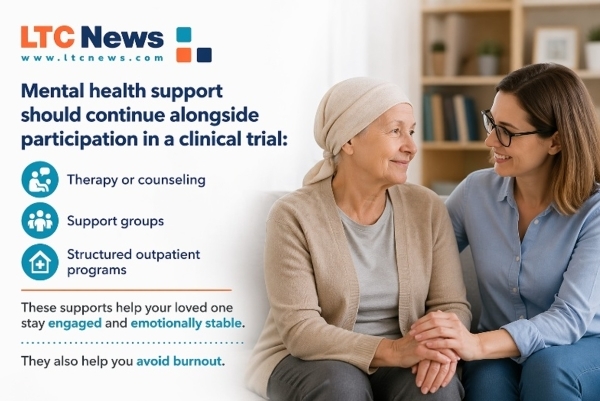
These supports help your loved one stay engaged and emotionally stable. They also help you avoid burnout.
Caregivers themselves also need support. The role of managing a loved one's trial participation, on top of everything else caregiving involves, is substantial. Connecting with caregiver support groups, respite care, or counseling services is not a luxury — it is a practical step toward sustaining the kind of consistent, attentive presence that good trial support requires.
When Participation Works Best
Clinical trials are essential. They drive innovation and improve care. But for your family, this is personal. Participation works best when:
- Mental health is supported
- Caregivers are prepared
- Expectations are realistic
- You have had an in-depth discussion with your doctor or specialist about the trial’s risks, benefits, and whether it aligns with your long-term care plan
Can Someone in Assisted Living or Memory Care Join a Clinical Trial?
If your loved one already lives in an assisted living community, memory care unit, or nursing home, you may assume clinical trials are no longer an option. That is not always the case.
Eligibility depends on the specific study, the individual’s health status, and the level of support available—but many older adults in care settings can still participate in certain types of research.
What Determines Eligibility?
Clinical trials set strict inclusion and exclusion criteria, which may include:
- Overall health and stability of chronic conditions
- Cognitive function and ability to provide informed consent
- Stage and progression of the disease being studied
- Ability to attend appointments or complete study requirements
For residents in memory care or those with cognitive impairment, participation may still be possible if:
- A legal representative (such as a healthcare proxy or power of attorney) can provide consent
- The study allows caregiver-assisted participation
- The individual can safely comply with study procedures
Types of Trials More Common in Care Settings
Older adults living in assisted living or nursing homes are more likely to qualify for:
- Quality-of-life or supportive care trials: Focused on comfort, mobility, sleep, or emotional well-being
- Medication management studies: Evaluating how drugs interact in older adults with multiple prescriptions
- Alzheimer’s or dementia-related trials: Often conducted in memory care environments with caregiver involvement
- Observational studies: These track health outcomes without requiring major treatment changes
More intensive trials—such as early-phase drug trials—may be less common due to stricter medical requirements.
Practical Considerations for Families
Even if your loved one qualifies, participation requires coordination.
You will need to consider:
- Whether the facility allows outside medical coordination
- Transportation to study sites, if required
- Staff availability to assist with medications or monitoring
- Communication between the research team and care providers
Some trials are designed to be conducted within care settings, which can make participation easier and less disruptive.
Balancing Opportunity With Reality
Clinical trials can offer access to new therapies and a sense of purpose. But for residents in assisted living or nursing homes, the decision should be grounded in comfort, safety, and quality of life.
Ask yourself:
- Will participation add stress or improve well-being?
- Does it align with your loved one’s current care goals?
- Are you and the facility equipped to support the process?
Frequently Asked Questions
How do clinical trials fit into long-term care planning?
Clinical trials are just one part of a broader care journey. If your loved one’s condition progresses, you may need to consider:
- In-home care
- Assisted living or memory care
- Nursing home services
Since Medicare does not cover long-term custodial care, planning ahead—including exploring Long-Term Care Insurance—can help protect your finances and ensure access to quality care.
Why are older adults often excluded from clinical trials?
Older adults are frequently excluded due to strict eligibility criteria, including chronic conditions, medication use, or mobility limitations. As a result, many treatments are tested on younger populations, even though older adults are the primary users.
Can someone with memory problems or early dementia participate?
In some cases, yes. Participation may be possible if:
- A legal representative can provide consent
- The study allows caregiver involvement
- The individual can safely follow study procedures
However, cognitive ability is a key factor in determining eligibility.
What should caregivers expect when supporting a clinical trial participant?
Caregivers often take on additional responsibilities, including:
- Transportation to appointments
- Medication management
- Monitoring symptoms
- Providing emotional support
Clinical trials can increase caregiver workload, so having a support system in place is important.
Can residents in assisted living or nursing homes join clinical trials?
Yes, some residents may still qualify. Eligibility depends on health status, the type of trial, and whether the facility can support participation. Trials focused on quality of life, dementia care, or medication management are more common in these settings.
What mental health factors should families consider?
Mental health plays a major role in successful participation. Depression, anxiety, and cognitive decline can affect:
- Motivation
- Ability to follow instructions
- Consistency in attending appointments
Addressing these issues before enrollment can improve outcomes and reduce stress.
Can a participant leave a clinical trial once it starts?
Yes. Participants have the legal right to withdraw from a clinical trial at any time, for any reason, without penalty. This is an important safeguard for older adults who may find participation too demanding.
Are clinical trials safe for older adults?
Clinical trials follow strict federal safety guidelines, but safety depends on the individual study and your loved one’s health. Older adults often have multiple conditions or medications, so it’s essential to review risks carefully with a doctor or specialist before enrolling.
Do clinical trials cost money?
Many clinical trials cover the cost of the treatment being studied and related care. However, they may not cover all expenses, such as travel, lodging, or caregiving support. Always ask for a full breakdown of costs before enrolling.
Should you talk to a doctor before joining a clinical trial?
Yes. Always discuss the trial with your doctor or specialist. They can help you understand:
- Risks and potential benefits
- Whether the trial fits your loved one’s condition
- How it aligns with your long-term care plan
What types of clinical trials are most suitable for older adults?
Older adults may qualify for several types of trials, including:
- Treatment trials for conditions like cancer or heart disease
- Prevention trials to slow disease progression
- Diagnostic trials for earlier detection
- Quality-of-life trials focused on comfort, mobility, and independence
Supportive care trials are often especially valuable because they focus on maintaining daily function and well-being.

Sponsored