After 50, Fear of Making Mistakes Can Lead to Costly Decisions in Retirement and Caregiving

About This Article
You expected clarity by your 50s. Instead, life gets more complex. Waiting for the “right” decision on retirement, caregiving, and long-term care may cost more than acting imperfectly.

Anna Marino
Anna Marino is a seasoned writer specializing in topics related to family, aging, and lifestyle in retirement. She shares advice on intergenerational relationships and strategies for enjoying retirement.
Table of Contents
- Why Your 50s Feel Heavier Than You Expected
- Why Your Brain Fears a Mistake
- Quiet Pressure to Be Right
- Impact of Denial
- Real Cost of Waiting Isn’t Obvious—At First
- Living in the Middle: The Sandwich Generation
- Why Your Brain Keeps You Stuck
- A Better Way Forward: Treat Decisions as Data
- One Area You Shouldn’t Ignore: Long-Term Care
- How to Move Forward Without Perfect Answers
- Ponder - Perfect Solutions Not Required
You’re standing in the kitchen, but you’re not really there. The dishwasher hums. A light over the stove flickers. There’s a stack of mail you haven’t opened—one envelope clearly marked tuition, another from an insurance company you’ve been meaning to call.
Your phone lights up. It’s your mom. Or your dad. Or your spouse texting from the other room about something practical that suddenly feels heavy. You don’t answer right away. Because, in that moment, everything feels connected.
If you make the wrong move now—retirement, money, helping your children, stepping in for your parents—does it unravel something else?
So you wait. You focus on making a mistake, yet not making a decision at all is often a mistake itself. You tell yourself you’re thinking it through. But what if you’re not waiting for clarity? What if you’re waiting for certainty that never comes?
Why Your 50s Feel Heavier Than You Expected
You likely imagined this stage differently. More control. More freedom. Fewer unknowns. Instead, your 50s often become a collision point—a compression of responsibility, financial, emotional, and physical, all happening at once:
- Your children still need financial or emotional support—even after college
- Your parents begin to decline, sometimes gradually, sometimes overnight
- Your career may be stable—or suddenly uncertain
- Your own health starts requiring attention you didn’t expect
- Retirement is no longer abstract—it’s approaching fast
This isn’t a slow transition. It’s everything, all at once—and much of it can’t be delayed. And every decision now feels like it carries weight across multiple parts of your life.
Why Your Brain Fears a Mistake
Our brains are actually wired to avoid mistakes because, thousands of years ago, a mistake could be life-threatening. If you ate the wrong berry or wandered into the wrong territory, it was a disaster. Today, our brains still react to a social mistake or a career error with that same "fight-flight-freeze" response. Your heart beats faster, your palms sweat, and your mind screams at you to stop. We "catastrophize," meaning we take a small error—like a typo in an email—and convince ourselves it will lead to being fired or losing all our friends.
Because our emotions can become so overwhelming when we face failure, it helps to observe them objectively. Learning how to use a mood tracker can be an excellent way to see these patterns. By recording how you feel when you make a mistake, you start to realize that the physical panic usually passes within a few minutes. Seeing that your "world-ending" fear is actually just a temporary spike in anxiety helps you stay grounded and realize that you are safe, even when you are wrong.
Quiet Pressure to Be Right
Earlier in life, mistakes felt like part of the process. Now they feel like something you can’t afford.
So your mindset shifts:
- Protect what you’ve built
- Avoid unnecessary risk
- Don’t make the wrong move
But that pressure creates something subtle and dangerous. As highlighted in the source material, many people begin to tie outcomes directly to their identity, turning every decision into a test instead of a learning process.
That’s when hesitation takes over.
You delay conversations. You postpone decisions. You keep gathering information. And while you’re trying to avoid mistakes, something else happens. You want to be wise and make the right decisions, but instead, you stop moving forward.
Impact of Denial
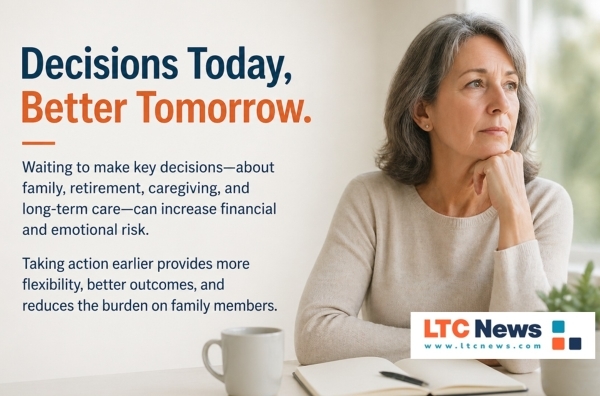
One of the most overlooked drivers of delay isn’t lack of information, it’s denial.
You may tell yourself:
- “It’s too early to worry about that.”
- “My parents are still doing fine.”
- “I’ll deal with this next year.”
- "I have plenty of time to think about it."
Denial isn’t irrational. It’s human.
As the number of choices grows further, the negatives escalate until we become overloaded. At this point, choice no longer liberates, but debilitates. — Dr. Barry Schwartz, author of The Paradox of Choice.
Facing aging, declining health, long-term care, or financial vulnerability forces you to confront uncomfortable truths about your future—and your family’s. So instead, it’s easier to push decisions forward, convincing yourself there’s more time.
But denial quietly shifts control away from you. Problems don’t pause. They progress. A small concern—a parent missing medications, a subtle memory issue, a financial gap—can turn into a crisis faster than expected. And when decisions are made in crisis, they are rarely optimal. They are reactive, rushed, and often more expensive—financially and emotionally.
Real Cost of Waiting Isn’t Obvious—At First
Waiting feels responsible. Even smart. But over time, it carries consequences that aren’t always visible until it’s too late. Even if you overcome denial, you still face consequences for delaying the decision-making process.
Procrastination is a form of unnecessary and voluntary delay… despite knowing there’s going to be negative consequences. — Fuschia Sirois, a leading researcher on procrastination, quoted in an American Psychological Association interview.
Financial Drift
Delaying decisions about retirement timing, investments, or income strategy reduces flexibility.
You lose:
- Time to adjust
- Opportunities to protect assets
- Control over how and when you draw income
In volatile markets, waiting can also mean being forced to make decisions under pressure instead of on your terms.
Family Strain
Avoiding difficult conversations rarely eliminates problems—it postpones them.
Without clear planning:
- Adult children are left guessing your wishes
- Siblings disagree on caregiving decisions
- Spouses carry unspoken stress
As of 2026, family caregivers now provide an estimated $600 billion in unpaid care annually, according to the AARP Public Policy Institute, often stepping in without preparation.
Health Consequences
Putting off preventive care or ignoring early symptoms can lead to larger, more complex health issues later—impacting independence and quality of life.
Emotional Weight
Perhaps the most immediate cost is the one you feel every day.
That low-grade stress. The mental tabs you keep open. You’re not acting—but you’re not at peace either. Avoiding decisions isn’t about time, it’s about emotion. That emotional avoidance is what allows decisions to quietly build pressure over time—until they can no longer be ignored
Procrastination is not a time management problem; it’s an emotion regulation problem. — Psychologist Timothy Pychyl, American Psychological Association.
Ask Yourself: What decisions are quietly building pressure in your life right now?
Living in the Middle: The Sandwich Generation
If you feel stretched thin, it’s not your imagination. You may be supporting two generations at once.
On one side:
- Children navigating careers, housing costs, or post-college transitions
On the other:
- Parents who may need help with transportation, health care, or daily living
Meanwhile, your own priorities don’t pause:
- Retirement planning
- Your health
- Your relationship with your spouse
- Spouses often carry different risk tolerances, timelines, and priorities
AARP reports that tens of millions of Americans are now in this position, balancing work, caregiving, and financial pressure simultaneously. Dr. Dilip Jeste has emphasized the connection between mental health, decision-making, and aging outcomes. Wisdom factors into aging and mental health.
Wisdom measures are increasingly being used to study factors that impact mental health and optimal aging. We wanted to test if a list of only seven items could provide valuable information to test wisdom. — Dilip V. Jeste, MD, former senior associate dean for the Center of Healthy Aging and Distinguished Professor of Psychiatry and Neurosciences at UC San Diego School of Medicine and now Director, Global Research Network on Social Determinants of Mental Health and Exposomics.
Every decision becomes a trade-off. There is no perfect answer. Only choices—and consequences.
Why Your Brain Keeps You Stuck
When faced with uncertainty, your brain doesn’t evaluate probabilities.
It reacts to perceived risk. What once protected humans from physical danger now shows up when you’re making modern decisions:
- Financial uncertainty
- Family conflict
- Health concerns
- Career transitions
You may notice:
- Overthinking
- Avoidance
- Worst-case scenario thinking
A small decision begins to feel like a permanent one. But in most cases, it isn’t.
A Better Way Forward: Treat Decisions as Data
Instead of asking, “Is this the right decision?” try asking: “What will this decision teach me?” That shift, reflected in the source material, reframes outcomes as information rather than judgment.
It changes how you move:
- A financial misstep becomes an adjustment
- A caregiving plan evolves as needs change
- A retirement timeline gets refined, not ruined
You’re not locked into one decision. You’re navigating a process.
One Area You Shouldn’t Ignore: Long-Term Care
This is one decision many people delay, long-term care and aging, and often, you delay this the longest. It’s uncomfortable. It’s complex. And it often feels far away—until it isn’t. Denial is often front and center.
But the reality is clear:
- Medicare only provides limited, short-term coverage for skilled care—generally up to 100 days after a qualifying hospital stay—not ongoing long-term care.
- As of 2026, about 56% of Americans will need significant long-term services and supports during their lifetime.
- Care often begins at home—and is frequently provided by family.
- Most long-term care starts at home and expands over time as needs increase.
- Many families are later forced to liquidate investments or rely on adult children when no plan is in place. Sometimes both.
Planning early gives you more control over:
- Where you receive care
- How it’s paid for
- How much burden falls on your family
Long-Term Care Insurance can help cover these costs with tax-free benefits, providing more choice and reducing family burden.
Waiting reduces those options.
Research: Review the LTC News Long-Term Care Insurance Learning Center
You can explore current care costs and local options using the LTC News Cost of Long-Term Care Services Calculator and Caregiver Directory (if you're looking for extended options for a loved one), giving you real data to make informed decisions before a crisis.
Individual situations vary, so professional guidance is essential when making long-term care decisions. Be sure to speak with a qualified long-term care specialist.
How to Move Forward Without Perfect Answers
You don’t need certainty. You need momentum.
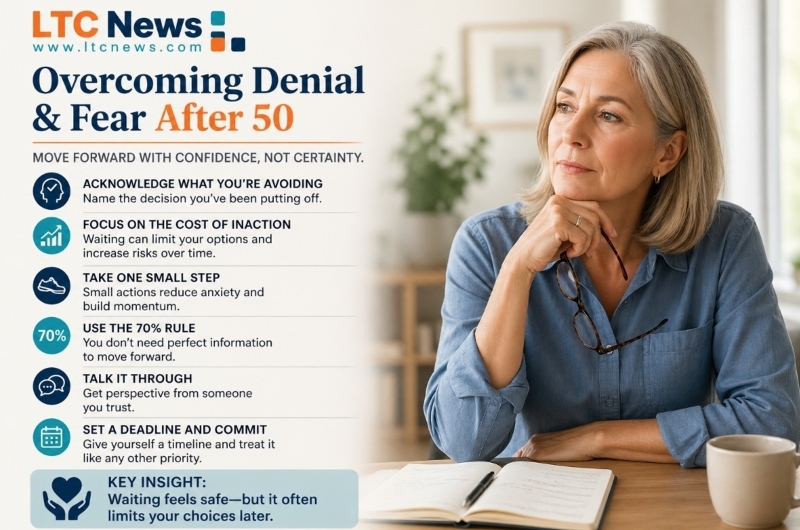
Use the 70% Rule
If you have most of the information, act. Waiting for 100% clarity often leads to no decision at all.
Make Big Decisions Smaller
You don’t have to solve everything today.
- Test retirement timing
- Explore care options early
- Adjust financial plans gradually
Separate Decisions From Identity
A decision may not work. That doesn’t define you.
Build Confidence Through Action
Confidence isn’t something you think your way into. It’s something you build by moving—and adjusting.
Ponder - Perfect Solutions Not Required
You’re still standing in that kitchen. Same house. Same responsibilities. Same unanswered questions. But here’s what’s changed. You don’t need to solve everything tonight. You don’t need perfect answers.
You just need to take the next step.
Because the longer you wait, the fewer choices you have. Because life, especially after 50, isn’t about getting everything right. It’s about not waiting so long that you lose the ability to choose at all.
So, ask yourself: What’s one decision you’ve been avoiding and what would progress look like this week?
Frequently Asked Questions
How common is the need for long-term care?
As of 2026, about 56% of Americans will require significant long-term services and supports during their lifetime. This makes planning for care an essential part of retirement and financial strategy.
What is one simple step to move forward today?
Start small. Identify one decision you’ve been avoiding and take a single step:
- Schedule a conversation
- Gather key information
- Explore one option
Progress—not perfection—is what reduces risk over time.
How does denial impact retirement and caregiving decisions?
Denial can delay critical planning by convincing you there’s still time. But issues like aging, health decline, or financial gaps continue progressing. Waiting often leads to reactive decisions that are more costly—financially and emotionally.
Does Medicare cover long-term care?
No. Medicare typically covers only short-term skilled care—generally up to 100 days after a qualifying hospital stay. It does not cover ongoing long-term care needs, which is why planning ahead is critical.
What happens if you wait too long to act?
Waiting can limit your options. Financial decisions become more constrained, care choices become reactive, and family members may need to step in without a clear plan—often increasing both cost and stress.
Why is long-term care planning often delayed?
Long-term care is frequently postponed because it feels distant, complex, or uncomfortable to address. However, most long-term care begins at home and expands over time, and waiting reduces your ability to control care choices and costs.
What are the real risks of waiting too long to plan?
Delaying key decisions can lead to:
- Reduced retirement income flexibility
- Increased family stress and conflict
- Higher long-term care costs
- Missed opportunities to protect assets
- Emotional strain from ongoing uncertainty
These risks often build gradually and aren’t obvious until options become limited.
What is the “sandwich generation,” and why does it matter?
Many people in their 50s are part of the “sandwich generation,” meaning they support both adult children and aging parents at the same time. This dual responsibility increases financial pressure, emotional stress, and the complexity of decision-making.
Why does fear of making a mistake lead to inaction?
The brain is wired to avoid risk, and even modern decisions can trigger a “fight-flight-freeze” response. This can cause overthinking, avoidance, and worst-case scenario thinking—making inaction feel safer than making a potentially imperfect choice.
Is delaying decisions actually harmful?
Yes. While waiting can feel responsible, research shows that delaying decisions often leads to worse outcomes. Over time, hesitation reduces financial flexibility, increases stress, and can force rushed decisions during a crisis instead of allowing thoughtful planning.
Why do people over 50 struggle to make important decisions?
As you enter your 50s, multiple responsibilities converge—retirement planning, supporting adult children, and caring for aging parents. This “compression of responsibility” can make every decision feel high-stakes, increasing fear of making a mistake and leading to hesitation.
What is the best way to overcome fear of making the wrong decision?
Instead of aiming for perfect decisions, focus on progress:
- Use the 70% rule—act when you have most of the information
- Break large decisions into smaller steps
- Treat decisions as data, not final outcomes
- Build confidence through action, not overthinking
This approach reduces pressure and keeps you moving forward.


Sponsored